Seeking Comfort in Second Cup’s English Breakfast Tea

Second Cup's English Breakfast Tea

Battling boredom and loneliness before departing from Montréal-Pierre Elliott Trudeau International Airport, and after doing several laps through the terminal and grabbing a bite of sushi, I needed another diversion. Lester’s smoked meat was tempting, but I had already gotten my fix a few days earlier at Snowden Deli. What I needed was a warm cuppa.

Second Cup, Canada’s answer to Starbucks, has a competing kiosk in the airport. I expected something comparable to the tea I would get at Starbucks (typically Tazo Awake) if I got tea at Starbucks (which I don’t).

English Breakfast was one of the options. Unlike Starbucks, all Second Cup teas — 10 varieties total — are packaged with the company’s own label. Second Cup’s website claims all its teas are whole leaf and Rainforest Alliance Certified™ and describes its English Breakfast as a blend of Indian (Assam) and Kenyan teas.

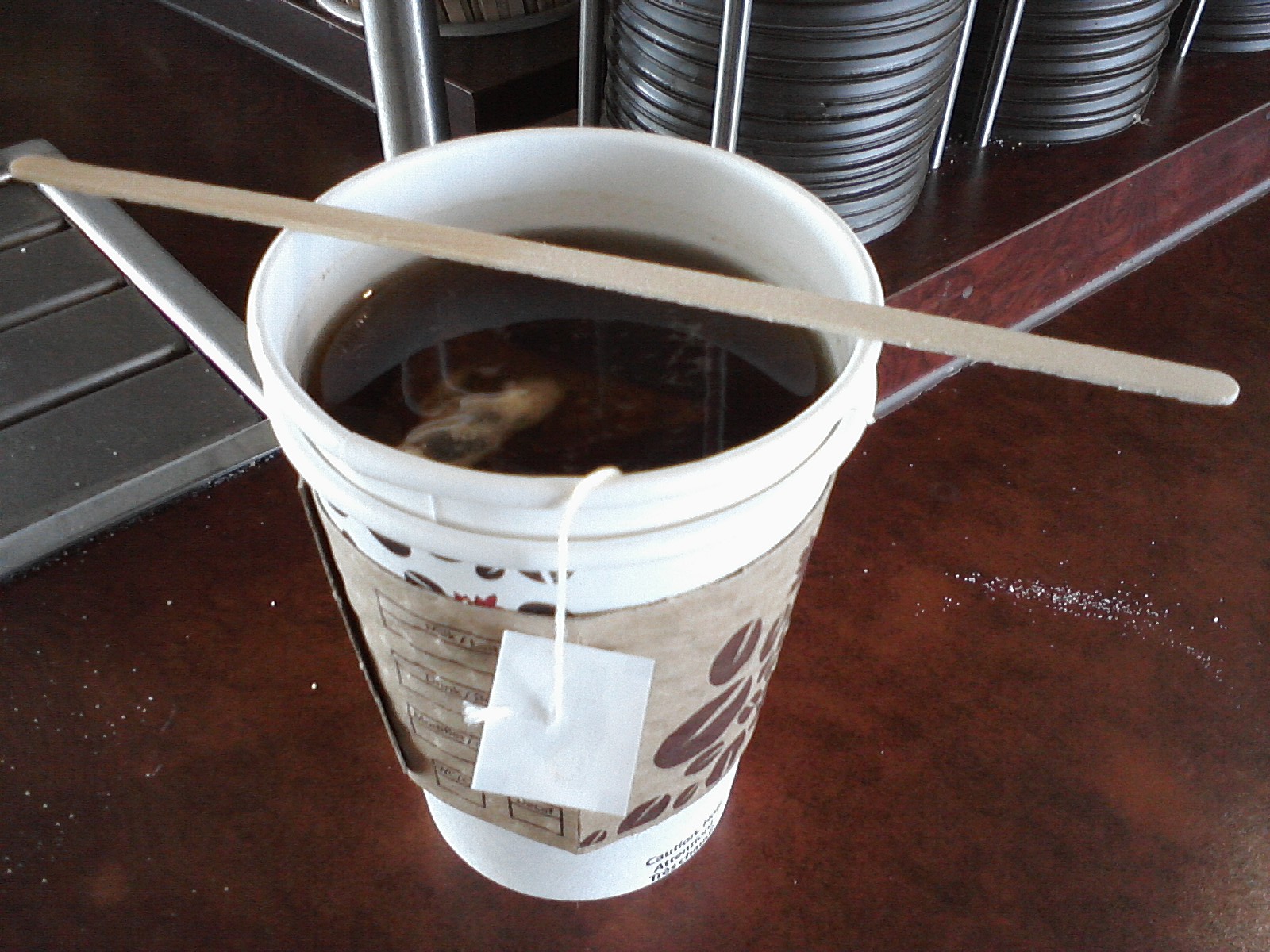
I placed my order and watched with disappointment (but not surprise) as my tea was steeped in hot instead of boiling water. Preparation method notwithstanding, the tea was good — something I attribute partially to the whole leaf tea and fat pyramid-shaped tea bag combination.

The tea was full bodied and stood up to milk very well. In addition to the familiar malty Assam, I detected a citrus-like aroma which I figured had to be the Kenyan. It had a bright finish and hit the spot.

Who servers better tea, Starbucks or Second Cup? Second Cup all the way. Go Canada!
Punjana Original Tea Bags

Punjana Original Tea

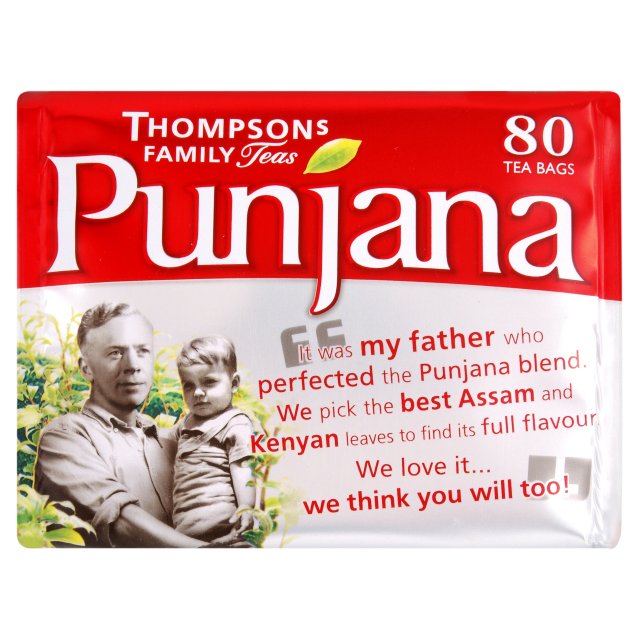
Impressed by the taste of Punjana Irish Breakfast Tea, I decided to give the original blend from the same company a try. Surprisingly, the best deal I found on Punjana Original Tea — also marketed as Punjana Everyday Tea — was through the company website, Punjana.com.

I paid £6.90 (£3.80 for the tea plus £3.10 for shipping) which, after my credit card was charged, set me back $11.17. Though I didn’t realize it at the time, this price actually includes two 80-packs of tea bags. That’s $5.59 per 80 pack — not quite the deal I found at Big Lots for the Irish breakfast blend ($3.50), but certainly the best I could find online for the original blend. The only downside to purchasing directly from Punjana (if you live in the United States) is the 3-4 week delivery time.

The difference between Punjana’s original and Irish breakfast blends is not well explained on the company website. Both products contain Assam and Kenyan teas and are described as being bright and refreshing.

As expected, Punjana’s Irish Breakfast tea is stronger in aroma and flavor than Punjana Original Tea, although they both have similar characteristics. Both exhibit a sweet citrus-like aroma and are full bodied and moderately astringent.

Those who like strong tea won’t be disappointed with Punjana Original; it is, after all, an Irish tea. For something with slightly more strength and character (a result of more Kenyan in the blend, possibly?), try Punjana Irish Breakfast. After drinking both for a couple of months, other popular English and Irish breakfast tea brands, by contrast, taste like cardboard to me.

Daintree Tea Review

Daintree Tea Review

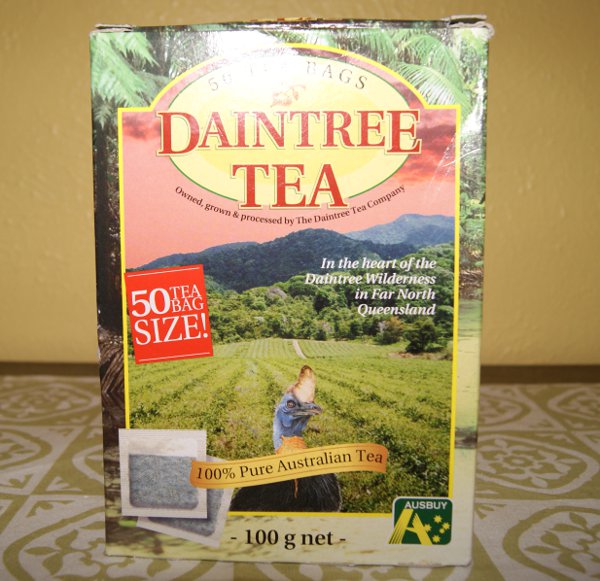
Over a year ago, my mother-in-law brought back a pack of Daintree Tea from her trip to Australia. I stuck it in the pantry and forgot about it until recently.

Daintree Tea is a black tea grown in the moist, tropical climate of Far North Queensland on the Daintree Plantation — so it says on the packaging. It is not a blend, but a true representation of the environment in which it is grown.

The package contains 50 tea bags. With the tea bag in the mug, I poured boiling water over it and let it steep for three minutes.

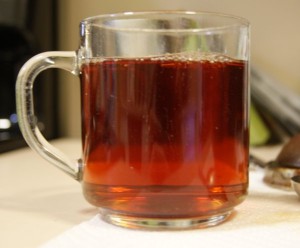
Daintree Tea’s aroma is semi-sweet and earthy with a hint of vanilla. For a full-bodied tea, the taste was pleasantly smooth. It certainly is unique among the black teas I’ve sampled. I was left well caffeinated and wanting more.

Does Good Decaf Tea Exist?

I Love Decaf Tea Mug From Zazzle.com

Until recently, it never occurred to me to try decaffeinated tea. I mostly kept my tea consumption confined to daylight hours, never going much beyond mid afternoon.

As my love of tea has grown, so has the urge for a post-dinner cuppa. Naturally caffeine-free herbal varieties are okay, but they are no substitute for my beloved black tea.

What I didn’t realize initially was how difficult it would be to find a good decaf tea. While doing research, I quickly learned about the four most commonly used methods used to extract the caffeine from the leaf. The CO₂ process seemed superior to the rest because it (supposedly) best retains the flavor of the original tea leaf without the use of a known carcinogen.

English Tea Store — an online tea merchant whose products and service have never disappointed me in the past — sells a decaf Irish Breakfast tea from which (according to their website) the caffeine is removed early, at the green leaf stage, using CO₂. The leaves are then left to mature. It sounded promising.

A funky chemical-like odor was the first thing I noticed when I smelled the dry tea leaves — very unusual, I thought, considering what I read about CO₂ caffeine removal. Unfortunately, that smell translated directly into a funky flavor when brewed.

The body of this decaffeinated tea was as full as English Tea Store’s regular Irish breakfast blend; however, the aroma and taste were way off. Because this was my first attempt at decaf tea, I can’t judge this tea too harshly. I have to assume that a good decaf cuppa is unattainable. Or, maybe the carcinogenic method of caffeine removal (a Methylene chloride solvent) is worth considering.

Boppin’ with Upton Tea’s Mangalam Estate GBOP Assam

Upton Tea's Mangalam Estate GBOP Cl. Spl Assam

I finally tried my first pure Assam tea with Mangalam Estate GBOP Cl. Spl (TA46) from Upton Tea. That crazy “GBOP” part of the the name has nothing to do with any music genre or dance style; it merely refers to the grade of the tea leaf. Not quite clear to me is the the meaning of “Cl. Spl”.

GBOP stands for Golden Broken Orange Pekoe. Orange Pekoe designates the size of the tea leaf. When you put the word “Broken” in front of it, you get an even finer (smaller) leaf because it has been torn or broken. If you go even smaller in leaf size than BOP, you get fannings and dust (which you find in many tea bags). At the time of this writing, I cannot explain to you with any certainty what meaning “Golden” adds to the equation.

I brewed a 4-cup teapot, letting it steep about 3.5 minutes. The final product was amber in color.

Immediately noticeable was a malty characteristic, which I recognize from the many Assam-rich, name-brand teas I drink on a regular basis. On the back end was a mild fruity flavor. A little honey was required to temper the bitterness, but overall, this tea was quite enjoyable.